The Complete Leather Jacket Buying Guide

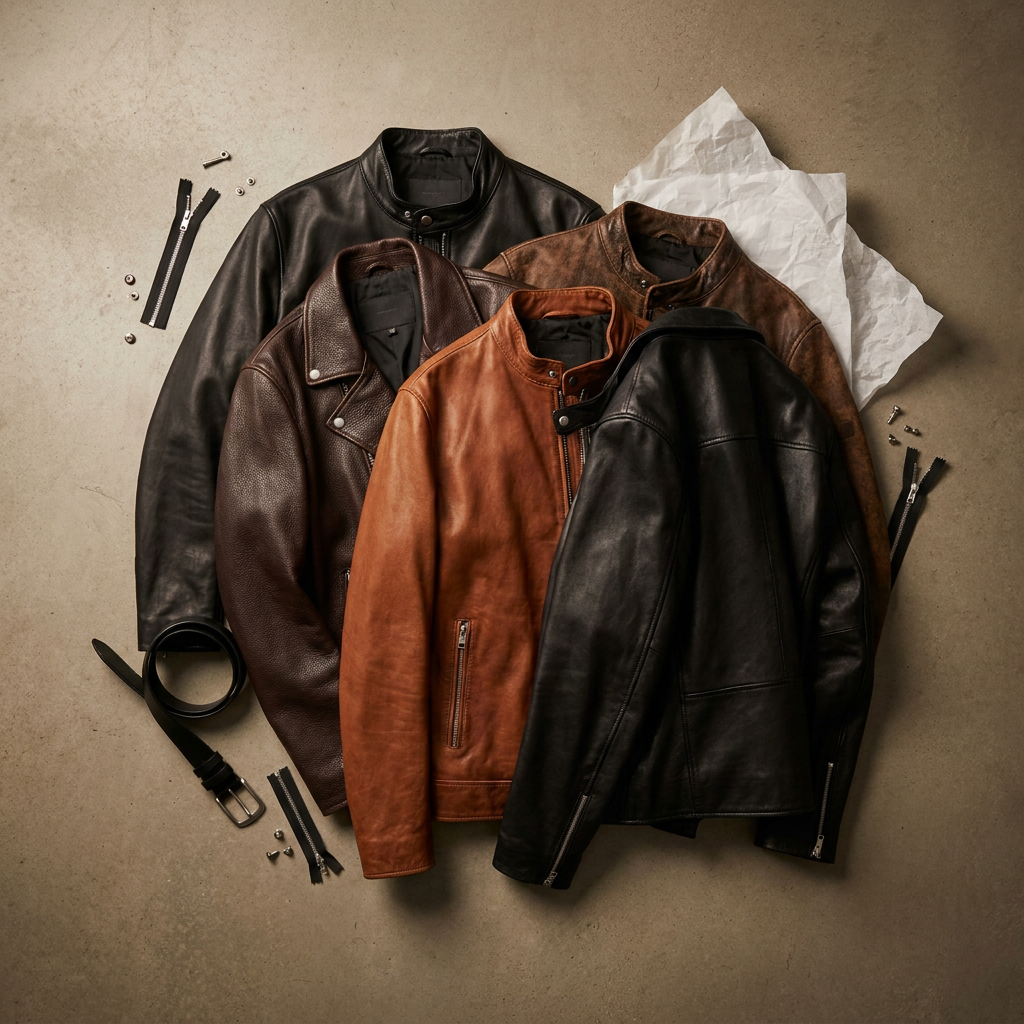
A leather jacket buying guide should answer five questions before you spend a dollar: which leather, which style, which fit, real or faux, and off-the-rack or custom. This guide answers all five in order, so you buy a jacket that fits your body, your wardrobe and your budget the first time. It covers every leather jacket style NYC Biker Jackets makes for men and women, and every order ships free with free returns.
A leather jacket is worth buying because, chosen well, it lasts ten years or more and improves with age. Chosen badly, it cracks, never fits right, and sits unworn. The difference is knowing what to look for and that is what the next 3,000 words give you.
1. What Makes a Good Leather Jacket?
A good leather jacket combines durable leather, a clean fit through the shoulders, solid hardware and tidy stitching. Those four things matter more than the brand label or the price tag. If a jacket has full-grain or top-grain leather, sits flat across your shoulders, has metal zippers that run smoothly, and shows even stitch lines, it is built to last.
Use this five-point check on any jacket before you buy:
- Leather grade — full-grain or top-grain, not “genuine” or bonded.
- Shoulder fit — the seam sits exactly at the edge of your shoulder.
- Hardware — metal zippers and snaps that move without catching.
- Stitching — straight, even lines with no loose threads.
- Lining — cleanly stitched in, breathable, holding the jacket’s shape.
The rest of this guide explains how to judge each point in detail.
2. Types of Leather Explained
The leather grade sets how long a jacket lasts and how it ages. Four grades cover almost every jacket on the market.
- Full-grain leather is the top layer of the hide with the natural grain intact. It is the strongest leather, develops a patina over years, and sits at the top of the price range.
- Top-grain leather has the surface lightly sanded for an even finish. It is softer and more uniform than full-grain, slightly less durable, and the most common choice for quality jackets.
- Genuine leather is a lower split of the hide. It is real leather but thinner and less hard-wearing, and it appears in budget jackets. The word “genuine” describes the lowest usable grade, not the best.
- Bonded leather is leather scrap ground up and glued onto a backing. It peels within a year or two. Avoid it.
The animal source changes the feel and weight of the leather:
- Lambskin is light, soft and smooth, and suits fitted biker jackets and dressier styles.
- Cowhide is thick, heavy and rugged, and suits classic bikers built for protection and long wear.
- Sheepskin and shearling keep the wool attached for warmth and define aviator jackets — see our women’s aviator jackets for the shearling-collar look.
- Goatskin is durable with a pebbled texture, often used in utility styles.
Two finishes are worth knowing. Nappa leather is full-grain or top-grain treated to be exceptionally soft and smooth, common in premium jackets. Suede and nubuck come from sanding the hide: suede is the soft napped underside, while nubuck is sanded top-grain — more durable than suede but still matte. Browse our men’s suede jackets for that softer, casual texture. For a full breakdown of every leather type, read our companion guide, Types of Leather Explained.
3. Real Leather vs Faux Leather
Real leather is more durable, ages better and lasts far longer than faux leather, but it costs more and needs occasional conditioning. Faux leather — also called PU or vegan leather — is lighter, lower in price and care-free, but it cracks and peels within a few years and does not develop a patina.
You can tell real and faux leather apart with four quick tests:
- Smell. Real leather has a rich, organic smell. Faux leather smells like plastic or chemicals.
- Grain. Real leather has an irregular, natural grain. Faux leather shows a uniform, repeating pattern.
- Edges. Real leather edges look rough and fibrous. Faux leather edges are clean, with a foam or fabric backing visible.
- Water. A drop of water soaks slowly into real leather. It beads and sits on faux leather.
Buy real leather if you want a jacket for the next decade. Buy faux leather if you need a low-cost jacket, a vegan option, or a style you expect to wear for only a season or two. Our guide How to Spot a Fake Leather Jacket covers this in more depth.
4. The Main Leather Jacket Styles
The style is the silhouette of the jacket. Six styles cover the leather jacket range at NYC Biker Jackets, and each links to its own collection for men and women.
- Biker (moto) jacket — A short, fitted jacket with an asymmetric zip and notched lapels. It is the most versatile leather jacket and the easiest to style. Shop men’s leather biker jackets and women’s leather biker jackets.
- Bomber jacket — A waist-length jacket with a ribbed collar, cuffs and hem and a straight front zip, with a relaxed, casual shape. See our men’s leather bomber jackets and women’s leather bomber jackets.
- Aviator jacket — A warm, structured jacket, often lined or trimmed with shearling, built for cold weather. Browse men’s aviator jackets.
- Hooded leather jacket — A leather jacket with an attached hood, usually in a biker or bomber cut. It reads casual and sporty and adds practical coverage. See hooded leather jackets for men and women.
- Letterman and varsity jacket — A sporty jacket with ribbed trims, contrast sleeves and a snap front, rooted in American college style. Shop our men’s letterman jackets and women’s varsity jackets.
- Leather vest — A sleeveless leather layer worn over shirts or under jackets, ideal for warm weather and layering. See our women’s leather vests.
For a tailored, dressier option, a leather blazer is cut like a suit jacket in leather. Choose the biker for everyday wear, the bomber for casual layering, the aviator for cold weather, the hooded jacket for a sporty look, the letterman or varsity jacket for a retro look, and the leather vest for warm-weather layering.
5. How Should a Leather Jacket Fit?
A leather jacket should fit close through the shoulders and chest with room for one light layer underneath. Fit is the single biggest reason a jacket gets worn or abandoned, so check it carefully.
- Shoulders. The seam should sit exactly at the edge of your shoulder, not on your arm and not above it. The shoulder is the one thing that cannot be altered well, so prioritize it above everything else.
- Chest. You should be able to zip the jacket fully over a t-shirt or a fine knit, with no pulling or gaping across the front.
- Sleeves. The cuff should end at your wrist bone. Slightly short is acceptable on a biker jacket; long is not.
- Length. A biker jacket ends at the waist or hip. A bomber ends at the waistband. An aviator sits at the hip.
- Mobility. Raise your arms and cross them in front of you. The jacket should move with you without straining at the shoulders or back.
Leather softens and gives roughly half a size with wear, so a quality jacket should feel snug but never tight on day one. If a jacket is tight in the shoulders when new, it will always be tight. For full measurement help, see our Leather Jacket Size & Fit Guide.
6. Men’s vs Women’s Leather Jacket Cuts
Men’s and women’s leather jackets share the same styles but use different cuts. Women’s jackets are shaped through the waist, have narrower shoulders, and often sit shorter and more cropped. Men’s jackets are cut straighter through the body with broader shoulders. Always buy the cut made for your body rather than sizing up or down in the other cut, because the shoulder and waist shaping will not match. A women’s jacket bought a size up still has narrow shoulders; a men’s jacket bought a size down still has a straight, boxy waist.
7. How to Choose a Color
Black is the most versatile leather jacket color and the easiest to style, which is why most buyers start there — browse our men’s and women’s black leather jackets. Brown and tan read warmer and more casual, and pair well with denim and earth tones; see our brown leather jackets for men and women. Bolder colors such as red work as statement pieces against a plain outfit, as in our women’s red leather jackets range.
If this is your first leather jacket, buy black — it works with the widest range of outfits. If it is your second, choose brown or tan to broaden your wardrobe, and save statement colors for your third.
8. Signs of Quality: Stitching, Hardware and Lining
Quality shows in the details a quick glance misses. Check four things before you buy.
- Stitching should be straight and even, ideally eight to ten stitches per inch, with no loose threads or skipped stitches. Stress points — shoulders, pocket corners, the base of the zipper — should be reinforced with extra stitching.
- Hardware — zippers, snaps and buckles — should be metal, not plastic, and should run smoothly without catching. Branded zippers such as YKK or Riri are a reliable sign of quality.
- Lining should be stitched in cleanly. Viscose or cupro linings breathe well and feel premium; polyester is acceptable in budget jackets; a quilted lining adds warmth.
- Panels. Fewer, larger leather panels mean larger, better hides were used. Many small panels stitched together can mean the maker used scraps.
A jacket that passes all four checks is built to last, regardless of where you buy it.
9. How Much Should a Leather Jacket Cost?
A real leather jacket from a quality maker usually costs between $200 and $600, with full-grain and designer pieces priced higher. Here is how the price tiers break down:
- Under $150 — Almost always faux leather or thin genuine-leather splits. Treat any “real leather” jacket at this price as a warning sign.
- $150–$300 — Entry-level real leather, often goatskin or mid-weight cowhide, with basic hardware.
- $300–$600 — Quality top-grain lambskin or cowhide, branded hardware and a proper lining. This is the value sweet spot for most buyers.
- $600+ — Full-grain leather, heritage construction and designer brand markup.
Price is driven by hide quality, hardware, lining, construction and brand markup. Treat a leather jacket as a cost-per-wear purchase: a $400 jacket worn for ten years costs four cents per wear, while three $100 jackets that crack within two years cost far more. Our spoke article How Much Should a Real Leather Jacket Cost? breaks the math down further.
10. Off-the-Rack vs Custom Leather Jackets
An off-the-rack leather jacket fits most bodies well and ships immediately, while a custom jacket is built to your exact measurements and choices. Buy off-the-rack if a standard size fits your shoulders and chest cleanly. Choose custom if standard sizes never fit your shoulders, if you want a specific leather, color or hardware, or if you want a jacket that is genuinely one of a kind.
NYC Biker Jackets builds made-to-measure jackets through its custom leather jacket service, so you control the leather, fit, hardware and details from the start. Custom is also the right route for letterman jackets with personalized patches and for team or wedding orders.
11. How to Care for a Leather Jacket
A leather jacket lasts longest with simple, regular care. Wipe the surface with a soft dry cloth after wear. Condition real leather two to three times a year to keep it from drying and cracking. Store the jacket on a wide hanger, away from direct heat and sunlight, and never in a plastic cover. Keep leather out of heavy rain, and if it does get wet, let it air-dry away from radiators. Treat suede with a dedicated suede brush and protector spray instead of conditioner.
Avoid four common mistakes: never machine-wash a leather jacket, never dry it on a radiator, never store it in plastic, and never over-condition it, which leaves the leather greasy. With the right routine, a quality leather jacket easily lasts ten years or more. Our Complete Leather Jacket Care Guide covers cleaning, conditioning and repairs step by step.
12. Common Leather Jacket Buying Mistakes
Most buyers regret a leather jacket for one of six reasons. Avoid all of them:
- Choosing price over shoulder fit. A cheap jacket that fits is better than a bargain that does not. The shoulder cannot be fixed later.
- Trusting the words “genuine leather.” Genuine leather is the lowest real-leather grade, not a quality stamp.
- Ignoring the lining. A thin, poorly stitched lining shortens the life of the whole jacket.
- Buying online without measuring. Measure your chest and shoulders and compare them to the size chart every time.
- Picking a trend color first. A first jacket in an unusual color limits how often you wear it.
- Skipping the return policy. Always confirm returns before you buy. NYC Biker Jackets offers free shipping and free returns so you can check the fit at home.
13. How to Choose Your First Leather Jacket
Your first leather jacket should be a black biker jacket in top-grain lambskin or cowhide, in a classic fit. This combination works with the widest range of outfits, suits almost every body, and is the easiest style to wear day to day. From there, your choice depends on how you will use it:
- For riders: prioritize heavy cowhide and a jacket with armor pockets over fashion details.
- For a dressier wardrobe: consider a clean, minimal biker jacket or a leather blazer.
- For cold climates: start with an aviator jacket with a shearling lining.
- For a hard-to-fit body: skip off-the-rack and go straight to a custom leather jacket.
Whatever you choose, buy the best leather grade your budget allows. A jacket is a long-term purchase, and the leather is the part you cannot upgrade later.
Frequently Asked Questions
What type of leather is best for a jacket?
Full-grain leather is the most durable and ages best, while top-grain leather is softer and more even. Lambskin suits fitted jackets, and cowhide suits rugged ones. For most buyers, a top-grain lambskin or cowhide jacket is the best balance of quality and price.
Is real leather worth it over faux leather?
Yes, if you plan to keep the jacket. Real leather lasts ten years or more and improves with age, while faux leather usually cracks within two to three years. Faux leather is only the better choice for a low budget, a vegan requirement, or a short-term style.
How much should I spend on a leather jacket?
A quality real leather jacket usually costs $200 to $600. Spending under $150 on a jacket sold as real leather is a warning sign of thin or mislabeled material.
How should a leather jacket fit?
The shoulder seam should sit at the edge of your shoulder, the jacket should zip over a light layer without pulling, and the cuffs should reach your wrist bone. The shoulder fit matters most because it cannot be altered well.
How long does a leather jacket last?
A well-made real leather jacket lasts ten years or more with basic care. Faux leather jackets typically last two to three years before cracking.
How can I tell if a leather jacket is real?
Real leather has a natural smell, an irregular grain, rough fibrous edges, and absorbs a drop of water slowly. Faux leather smells of plastic, has a uniform repeating grain, clean backed edges, and beads water on the surface.
Can you wear a leather jacket in the rain?
Light rain is fine, but heavy rain is not. Water can stain and stiffen leather. If a jacket gets wet, let it air-dry away from direct heat, and use a protector spray on suede.
What is the difference between a biker jacket and a bomber jacket?
A biker jacket is short and fitted with an asymmetric zip. A bomber jacket is looser with a ribbed collar, cuffs and hem and a straight front zip.
Should I buy a leather jacket online or in store?
Online is fine when you measure yourself and the retailer offers free returns, since you can check the fit at home and send it back if it is wrong. NYC Biker Jackets offers free shipping and free returns for this reason.
Do leather jackets stretch over time?
Yes, slightly. Leather gives roughly half a size with wear, mainly through the body and sleeves. Buy snug but never tight, and never size up expecting a major stretch.